
Kiwi FY26 results show a fintech growing fast but spending far faster. The Bengaluru-based credit-on-UPI startup reported operating revenue of ₹16 crore for the year ended March 2026, up more than four times from ₹3.8 crore in FY25. Over the same year it spent ₹105 crore on advertising and promotion, up 2.7 times from ₹38.5 crore, and its net loss doubled to ₹129.5 crore from ₹64.2 crore.
By our calculation, Kiwi spent about ₹6.56 on advertising for every ₹1 of operating revenue. The figures come from the company’s financial statements filed with the Registrar of Companies, as reported by Entrackr.
Kiwi FY26 results: key facts
- Operating revenue: ₹16 crore, up from ₹3.8 crore in FY25
- Total income: ₹24.9 crore, including ₹8.9 crore of other income from fixed-deposit interest and the sale of mutual funds
- Total expenses: ₹154.5 crore, up from ₹73.8 crore
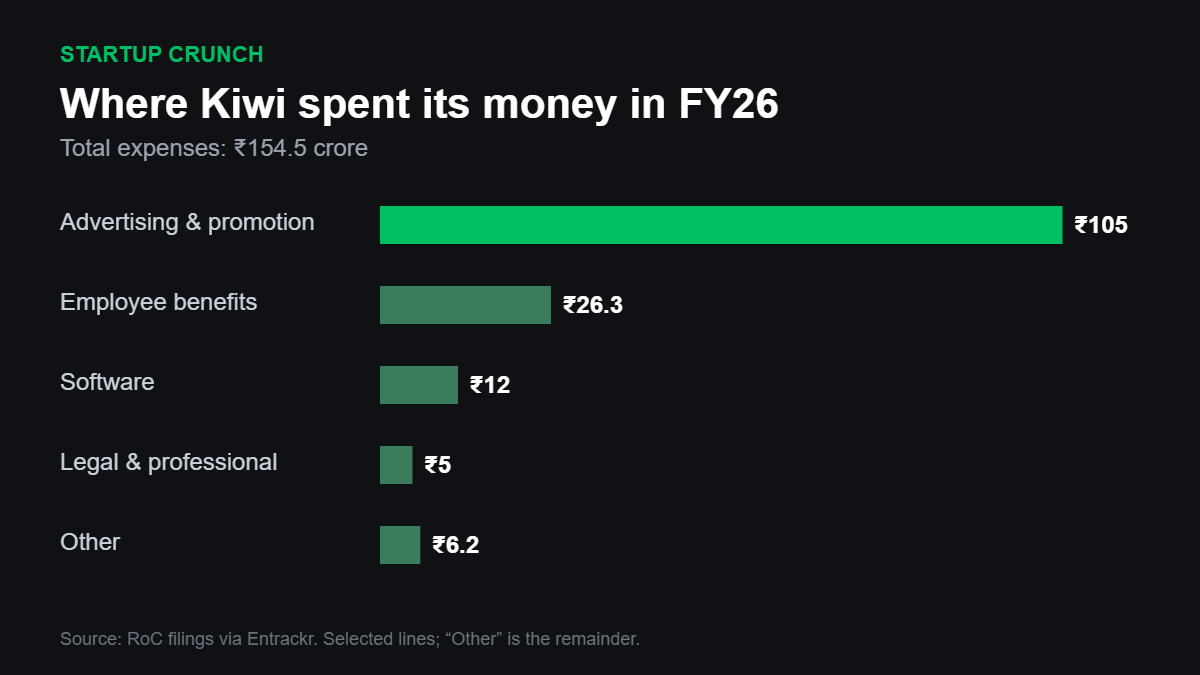
- Advertising and promotion: ₹105 crore, or 68% of total expenses
- Net loss: ₹129.5 crore, up from ₹64.2 crore
- EBITDA loss: ₹138 crore, an EBITDA margin of -863.13%
- Spend per rupee of operating revenue: ₹9.66
- Company: Bengaluru credit-on-UPI startup launched in 2022 by Siddharth Mehta, Anup Kumar Agrawal and Mohit Bedi
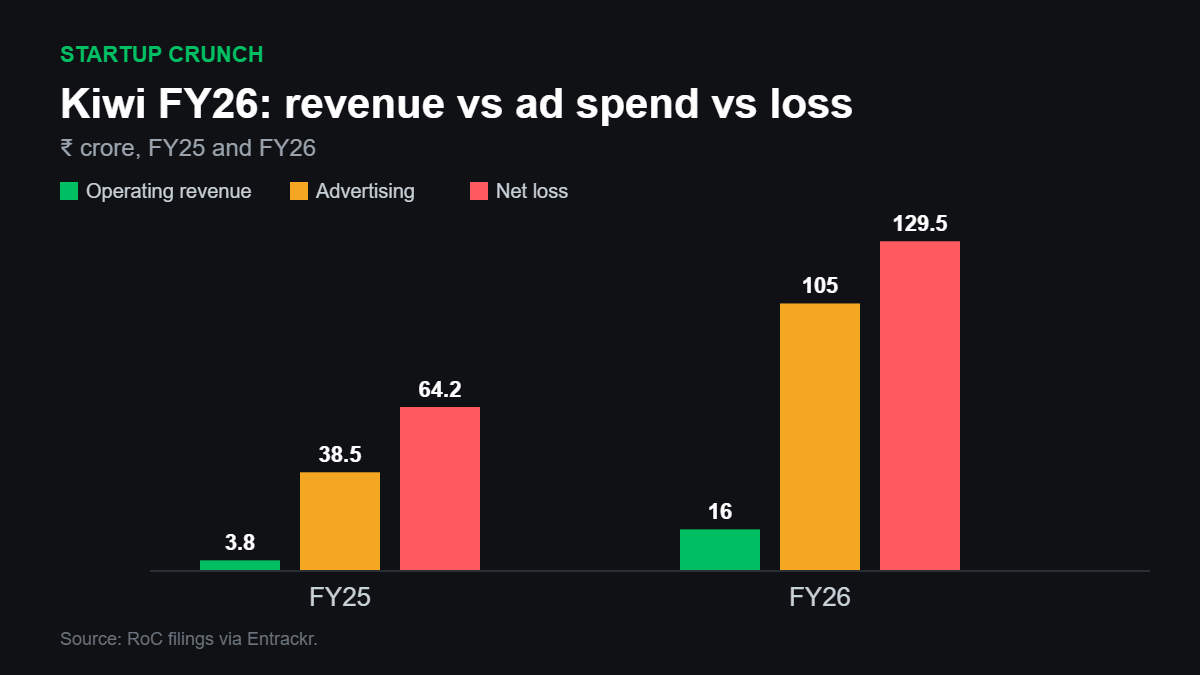
Kiwi FY26 vs FY25 at a glance
Comparing the two years shows how much bigger the business got, and how much more it cost:
- Operating revenue: up about 4.2 times, from ₹3.8 crore to ₹16 crore
- Advertising: up 2.7 times, from ₹38.5 crore to ₹105 crore
- Total expenses: up about 2.1 times, from ₹73.8 crore to ₹154.5 crore
- Net loss: up about 2 times, from ₹64.2 crore to ₹129.5 crore
- Ad spend per rupee of revenue: down from about ₹10.1 to about ₹6.6
Revenue grew faster than every cost line, which is the right direction. But because it started from such a small base, the gap between what Kiwi earns and what it spends still widened in rupee terms.
Kiwi FY26 advertising: where the money went
Advertising was by far Kiwi’s largest cost, at 68% of expenses. Entrackr said the line likely covers customer acquisition campaigns, cashback and other promotions. The company has not broken it down.
Other costs were much smaller:
- Employee benefits: ₹26.3 crore, up 15.6% from ₹22.75 crore, including ₹5.8 crore of ESOP-related expense
- Software: ₹12 crore, double the previous year
- Legal and professional: ₹5 crore, up from ₹4 crore
By our calculation, ad spend was about 10.1 times operating revenue in FY25 (₹38.5 crore against ₹3.8 crore) and about 6.6 times in FY26. Kiwi spent more on ads in rupees, but less for each rupee of revenue it earned. That is the one clear sign of improving efficiency in the Kiwi FY26 numbers.
How big is the Kiwi FY26 loss?
The Kiwi FY26 EBITDA loss was ₹138 crore, giving an EBITDA margin of -863.13%. Its return on capital employed was -86.94%.
The Kiwi net loss adds up. Total income of ₹24.9 crore minus expenses of ₹154.5 crore gives about ₹129.6 crore, which matches the reported ₹129.5 crore within rounding. Other income of ₹8.9 crore softened the blow. Without it, expenses would have exceeded operating revenue by ₹138.5 crore, by our calculation.
Some reports described the loss as “nearly doubling”. By our calculation, ₹129.5 crore is 2.02 times ₹64.2 crore, so it slightly more than doubled.
What Kiwi sells and how it makes money
Kiwi lets people pay with credit on UPI. Users can link RuPay credit cards to UPI and pay by scanning QR codes, the same way they would with a bank account. Its products include co-branded RuPay credit cards that earn cashback, and Kiwi Postpaid, a bank-backed credit line that works on UPI and is repaid through a monthly bill. Its partner banks include YES Bank, Punjab National Bank and AU Small Finance Bank.
Kiwi revenue comes mainly from sharing income with its partner banks on card distribution and transaction volumes. It may add income from premium memberships and platform fees in future. The model depends on persuading many people to take up a card, which is why customer acquisition costs so much.
Kiwi funding and ownership
Kiwi has raised around $43 million to date. Its rounds include a $13 million Series A in November 2023 led by Omidyar Network India, and a $24 million (about ₹209 crore) Series B in 2025 led by Vertex Ventures SEA & India, with Nexus Venture Partners, Stellaris Venture Partners and Omidyar Network India also taking part, Inc42 reported. By our calculation, the remaining roughly $6 million came from earlier rounds.
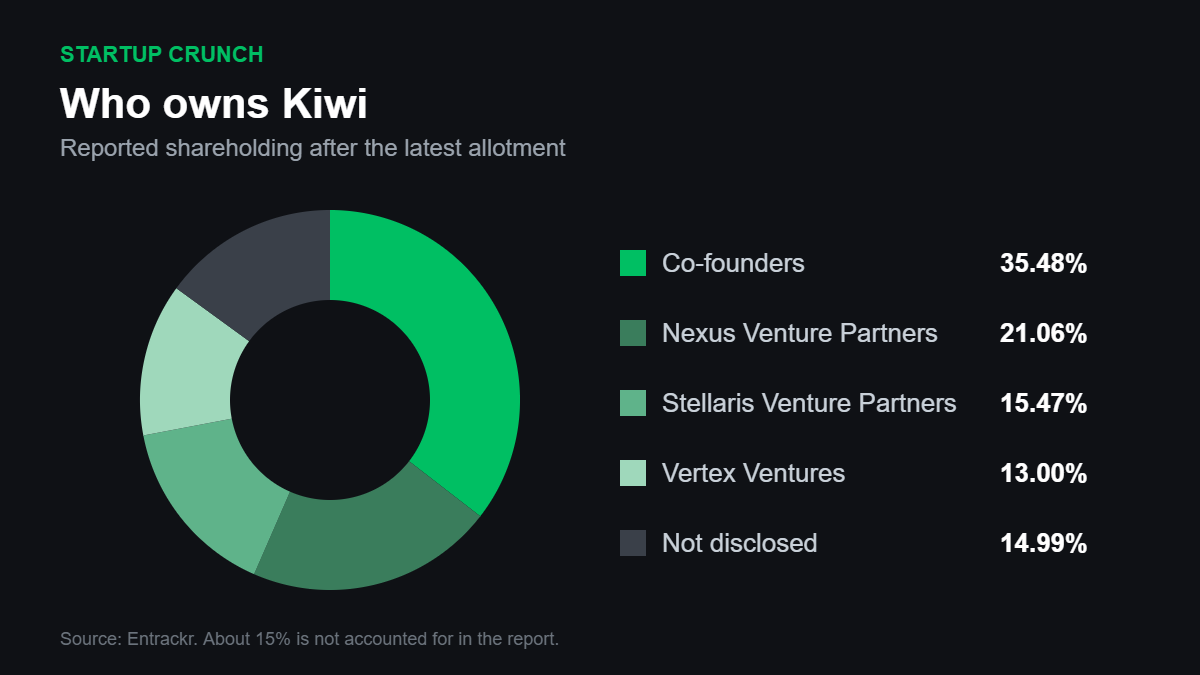
After the latest share allotment, the reported holdings are:
- Nexus Venture Partners: 21.06%
- Stellaris Venture Partners: 15.47%
- Vertex Ventures: 13%
- Co-founders combined: 35.48%
These stakes add up to about 85%. The report does not say who holds the rest, and Kiwi has not disclosed its valuation. By our calculation, the Kiwi FY26 net loss equals about 62% of the Series B. Part of the loss is non-cash, such as ESOP expense, so this is not the same as cash burn.
How credit on UPI works
UPI began as a way to send money straight from a bank account. In 2022, the Reserve Bank of India allowed RuPay credit cards to be linked to UPI, and in 2023 it extended UPI to pre-approved credit lines from banks. This means a shopper can scan the same QR code at a small store but pay using credit instead of their savings.
For shops, nothing changes: they keep accepting UPI. For card issuers and fintechs like Kiwi, it creates a way to reach millions of people who rarely used credit cards because few small merchants had card machines.
What the Kiwi FY26 results mean for credit on UPI
Credit on UPI is one of the most watched areas in Indian fintech. Allowing RuPay credit cards and pre-approved credit lines on UPI opens credit payments to millions of shops that accept QR codes but not card machines. Banks, fintechs and big payment apps are all competing for these users.
The Kiwi FY26 numbers show how expensive that race is. Kiwi revenue is growing quickly from a small base, but each new user still costs far more to win than the company earns from them today. The key question for its investors is whether revenue per user rises fast enough, as cards get used more often, to cover the cost of acquiring them. Read more of our coverage of startup earnings and funding, including Foxtale’s FY26 results.
Can Kiwi turn its revenue growth into profit?
On the Kiwi FY26 numbers, the company would need to grow revenue many times over, or cut costs sharply, to break even. Kiwi revenue of ₹16 crore covered only about a tenth of its ₹154.5 crore in expenses.
There are two levers. The first is getting more value from each user: if people who already hold a Kiwi card use it more often, revenue rises without new acquisition spending. The second is lowering what it pays to win each new user, which shows up as advertising falling as a share of revenue. That share did fall in FY26, from about 10 times revenue to about 6.6 times.
Until Kiwi discloses its user numbers and cash balance, it is hard to say how long its current funding will last. The Kiwi net loss of ₹129.5 crore in a single year is a large sum next to the roughly $43 million it has raised in total.
What is not known
- Users and cards: Kiwi has not said how many users or cards it has.
- The ₹105 crore ad line: the split between ads, cashback and promotions is not disclosed.
- Cash in hand: the cash balance at the end of FY26 has not been reported.
- Kiwi’s view: no company statement has been published.
- Valuation and path to profit: neither has been disclosed.
What to watch next
- Whether Kiwi raises new capital.
- Whether revenue keeps growing faster than ad spend.
- Whether it discloses the number of cards issued or active users.
- How the credit-on-UPI market changes as banks expand their own offers.
Frequently asked questions about Kiwi FY26
What was Kiwi revenue in FY26?
Kiwi’s operating revenue was ₹16 crore in FY26, up more than four times from ₹3.8 crore in FY25. Total income, including other income, was ₹24.9 crore.
What was the Kiwi FY26 net loss?
Kiwi reported a net loss of ₹129.5 crore in FY26, about double the ₹64.2 crore loss in FY25.
How much did Kiwi spend on advertising in FY26?
Kiwi spent ₹105 crore on advertising and promotion, up 2.7 times from ₹38.5 crore. That was 68% of its total expenses.
How much has Kiwi raised?
Kiwi has raised around $43 million, including a $13 million Series A led by Omidyar Network India and a $24 million Series B led by Vertex Ventures SEA & India.
Who founded Kiwi?
Kiwi was founded by Siddharth Mehta, Anup Kumar Agrawal and Mohit Bedi. It is based in Bengaluru and launched in 2022.
What does Kiwi do?
Kiwi offers RuPay credit cards that work on UPI and Kiwi Postpaid, a bank-backed credit line for UPI payments, with partner banks such as YES Bank, PNB and AU Small Finance Bank.