
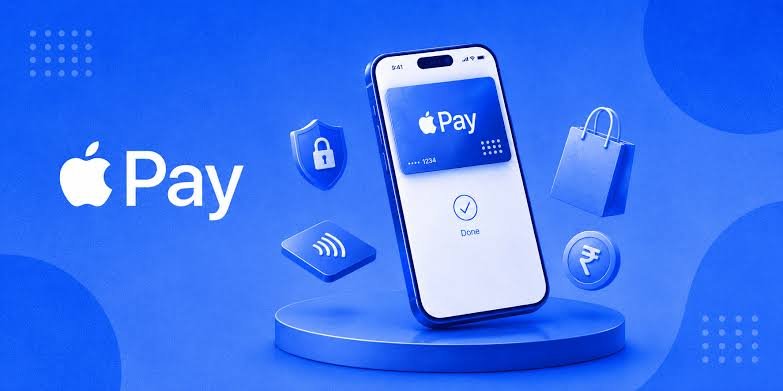
Apple is preparing to launch Apple Pay in India as early as next month, starting with Axis Bank credit cards, according to a Reuters report published on September 18 that cited three people familiar with the matter. It would mark the service’s long-delayed debut in one of the world’s largest digital payments markets, nearly a decade after Apple first signalled interest in bringing it to the country.
Talks are also underway with HDFC Bank and ICICI Bank, India’s largest and third-largest credit card issuers respectively, though commercial terms with those lenders have not been finalised. Apple, Axis Bank, HDFC Bank and ICICI Bank either declined to comment or did not respond when Reuters sought comment for its report.
The launch matters not just because of the wait involved, but because of what it will leave out. Apple Pay’s initial India rollout is expected to work only with Visa and Mastercard credit cards, according to earlier reporting by Business Standard and the Economic Times through August and September. The Unified Payments Interface, which accounts for the overwhelming majority of India’s digital payment volume, will not be part of the service at launch.
Why UPI is missing at launch
To support UPI transactions, Apple would need separate approval from the National Payments Corporation of India and a partnership with a sponsor bank to route those payments — requirements the company has not yet met, according to multiple reports. The domestic RuPay card network is also absent from the initial rollout.
That leaves Apple Pay entering India through its credit-card business alone, a considerably smaller slice of the country’s payments landscape than UPI. India’s total credit card base stood at 12.29 crore (122.9 million) cards as of July 2026, up 9.9% year-on-year, according to Reserve Bank of India data analysed by 1Lattice and reported by BW Businessworld. Total credit card spending topped Rs 2 lakh crore a month for three consecutive months through July 2026, Business Standard reported, citing RBI data.
The fee dispute behind the delay
Part of why the launch has slipped past its originally reported mid-2026 target comes down to money. Business Standard reported on August 9 that Apple has been negotiating for a 15-20 basis point share of the interchange fee on every credit card transaction routed through Apple Pay, while large Indian card issuers have been countering with an offer closer to 10 basis points. One basis point equals 0.01 percentage points, and any such fee would come out of banks’ existing interchange earnings rather than being charged separately to cardholders or merchants.
Apple’s fee ask is not unusual by its own global standards. A US Department of Justice antitrust complaint against Apple disclosed that the company already charges American issuing banks a flat 15 basis points on every Apple Pay credit transaction, a fee the DOJ said generates roughly $1 billion a year for Apple globally. Judged against that benchmark, Apple’s proposed India fee sits close to its existing global rate rather than representing an unusual India-specific premium — though Indian banks are negotiating against the backdrop of a UPI network that charges no fees on the vast majority of transactions.
A Bloomberg report from February 2026 had earlier said Apple was in talks with ICICI Bank, HDFC Bank and Axis Bank with a view to launching around the middle of the year, a timeline that has since slipped by several months.
Who Apple is talking to
Axis Bank, the lender Reuters named as Apple’s likely launch partner, was India’s fourth-largest credit card issuer as of July 2026, with 16.26 million active cards and roughly 13% market share, behind HDFC Bank (26.97 million cards, 22% share), SBI Card (22.76 million cards, 19% share) and ICICI Bank (19.69 million cards, 16% share), according to RBI data analysed by 1Lattice.
If HDFC Bank and ICICI Bank eventually sign on alongside Axis Bank, the three private lenders would together account for roughly 62.9 million cards — about 51% of India’s entire credit card base. An Axis-only launch, by contrast, would give Apple Pay access to a much smaller slice of that market to start.
Apple’s push into India’s payments market follows a related move in July 2026, when the company resumed accepting Visa and Mastercard credit and debit cards for Apple Account purchases in India — including iCloud+, Apple Music and App Store payments — ending a four-year suspension of card-based billing in the country. Pine Labs CEO Amrish Rau, speaking on the company’s June-quarter earnings call as reported by Business Standard, said credit card usage in India was already growing 10-15% and that Apple Pay’s entry was likely to expand card volumes further rather than take share from UPI, since the two rails largely serve different types of transactions.
NPCI’s pre-emptive move
Eight days before the Reuters report on Apple’s India plans, NPCI unveiled its own contactless payment feature, UPI Tap & Pay, which lets users complete a UPI payment by tapping an NFC-enabled smartphone on a compatible point-of-sale terminal without opening the UPI app. Reserve Bank of India Governor Sanjay Malhotra announced the feature, alongside an AI-powered assistant called MyUPI built on NPCI’s in-house language model, at the Global Fintech Fest in Mumbai on September 10.
UPI Tap & Pay waives the UPI PIN for transactions up to Rs 5,000 and does not require an active mobile data connection, since it relies on the point-of-sale terminal’s own connectivity. The timing has led some analysts to read the launch as a pre-emptive move to match the contactless convenience that has long been one of Apple Pay’s key selling points in the more than 90 markets where it already operates, before Apple Pay even arrives in India.
The backdrop underscores the scale UPI already commands: the network processed a record 24.51 billion transactions worth Rs 29.82 lakh crore in August 2026, NPCI data released on September 1 showed, up 3.6% from July and 22% higher than a year earlier, with 752 live member banks on the platform.
Market reaction
Shares of Apple rose 1.38% intraday following the Reuters report on September 18, while Axis Bank gained 0.25%, HDFC Bank climbed 1.95% and ICICI Bank slipped 0.27%, according to moves tracked by Investing.com. The muted overall reaction across the three Indian lenders suggests investors are not yet pricing in a material earnings impact, consistent with the fact that only one banking partnership has been reported so far and India remains a small contributor to Apple Pay’s global transaction volume.
What comes next
As of now, neither Apple nor Axis Bank has publicly confirmed the launch, and the reported October timeline, the Axis Bank partnership, and the exclusion of UPI at launch all rest on unnamed sources cited by Reuters and earlier reports from Business Standard and the Economic Times. Apple’s own Apple Pay availability page did not list India among supported markets as of September 19. Whether HDFC Bank and ICICI Bank sign on, and when — or if — Apple eventually secures the NPCI approval and sponsor-bank arrangement needed to add UPI support, remain open questions that will shape how much of India’s payments market Apple Pay can realistically reach.
