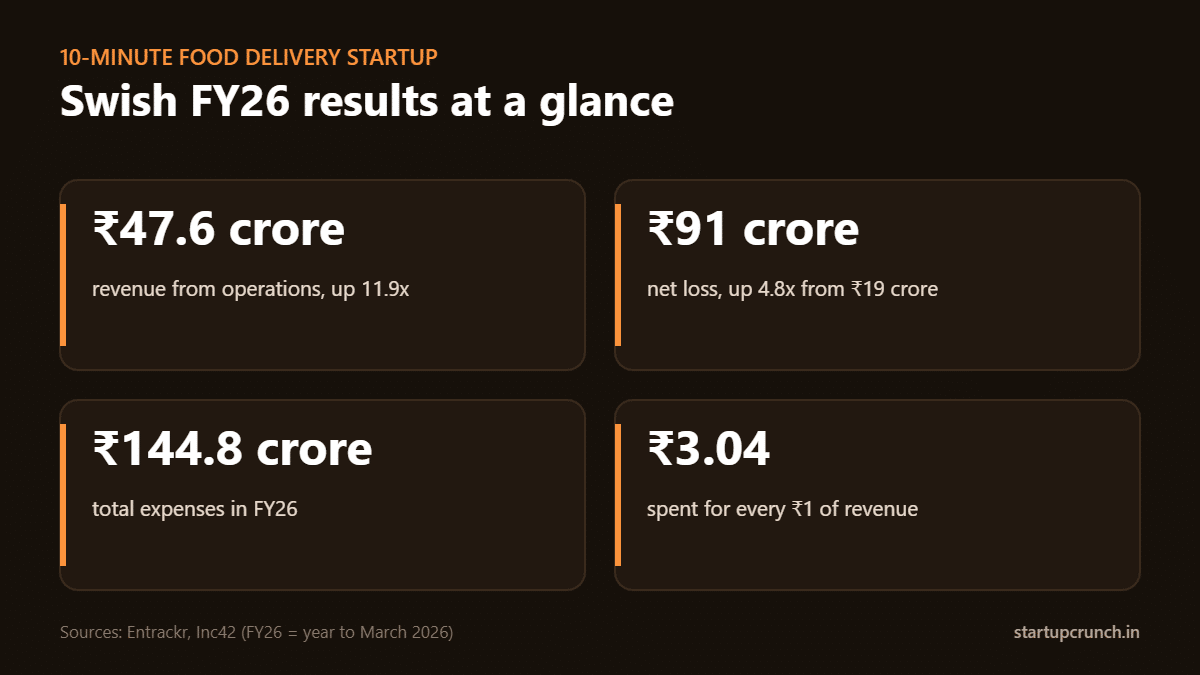
Swish FY26 results show the 10-minute food delivery startup grew revenue from operations 11.9 times to ₹47.6 crore, while its losses rose 4.8 times to ₹91 crore, according to its financial statements reported by Entrackr. Total expenditure was ₹144.8 crore, up from ₹23.2 crore in FY25.
Swish spent Rs 3.04 for every rupee of operating revenue. Employee costs were the largest item, at ₹55.7 crore.
Swish FY26 results: key facts
- Company: Swish, Bengaluru, founded in 2024
- Year: FY26, ended March 2026
- Revenue from operations: ₹47.6 crore, up 11.9X
- Total income: ₹53.75 crore, including about ₹6 crore of interest on bank deposits
- Total expenses: ₹144.8 crore, against ₹23.2 crore in FY25
- Net loss: ₹91 crore, up 4.8X from ₹19 crore in FY25
- EBITDA margin: -193.2%
- Spend per ₹1 of revenue: ₹3.04
- Cash and bank balances (March 2026): ₹28 crore
- Total funding raised: About $78 million
Swish revenue: all from food sales
The sale of food products was the company’s sole source of operating revenue. It also earned around Rs 6 crore in interest income on bank deposits, taking total income to Rs 53.75 crore.
An earlier report said Swish launched in July 2024 and reported Rs 4 crore in revenue and a total loss of Rs 19 crore during the eight-month period of FY25. That matches the 11.9X jump, since ₹47.6 crore divided by 11.9 is about ₹4 crore. Because FY25 was a short year, the growth figure compares a full year with about eight months.
Where Swish’s money went
| Cost | FY26 | FY25 | Share of total |
|---|---|---|---|
| Employee benefits | ₹55.7 crore | ₹10.4 crore | 38.47% |
| Cost of materials | ₹39.5 crore | ₹5.75 crore | 27.28% |
| Marketing and branding | ₹19 crore | ₹2.03 crore | 13.12% |
| Rent | ₹6.16 crore | Not given | Not given |
| Registration, renewals and subscriptions | ₹4.64 crore | Not given | Not given |
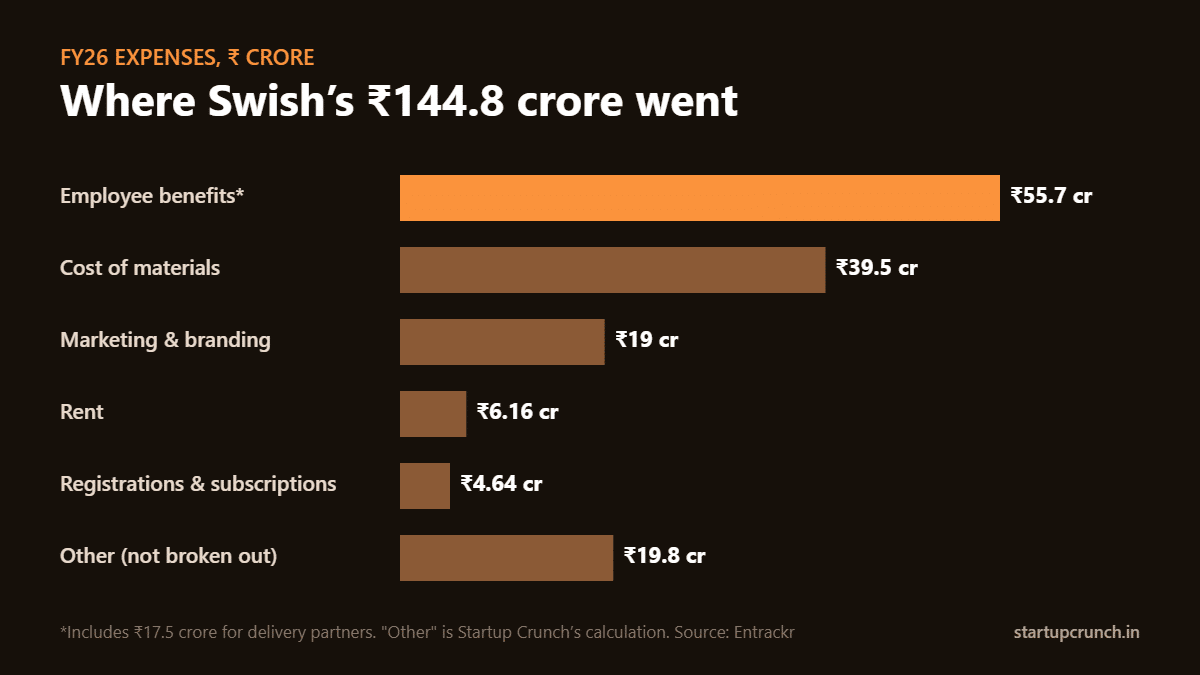
Employee costs grew 5.4 times, and ₹17.5 crore of the total went to delivery partners. Cost of materials, which covers ingredients and inputs, grew 6.9 times, and marketing grew 9.4 times.
By our calculation, these five items add up to about ₹125 crore. That leaves about ₹20 crore for kitchen operations, housekeeping, professional charges, logistics and other overheads, which the report does not break out.
How big is Swish’s FY26 loss?
Net loss was ₹91 crore (₹91.1 crore, per Inc42), up 4.8 times from ₹19 crore in FY25. Inc42 describes the rise as close to 4X, but the FY25 figures support 4.8X: Swish had total income of about ₹4.2 crore against expenses of ₹23.2 crore that year, a loss of about ₹19 crore. The ₹23.2 crore figure is FY25 spending, not the FY25 loss.
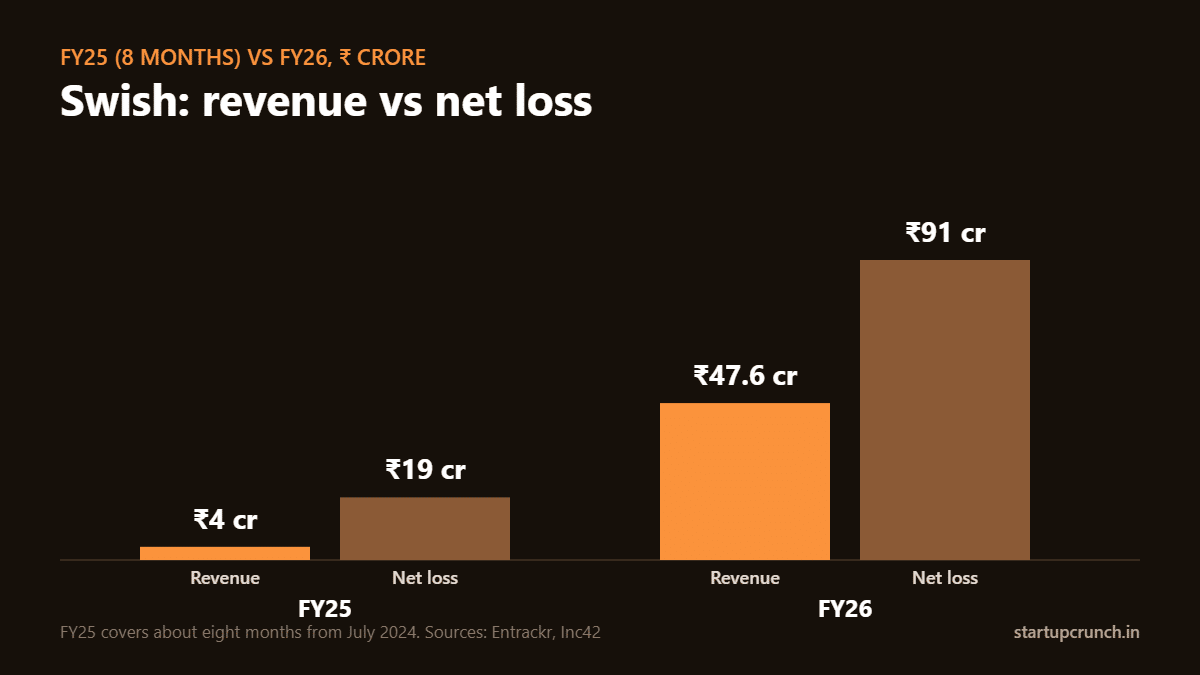
By our calculation, the ₹91 crore loss is about 1.9 times the ₹47.6 crore of revenue. Return on capital employed was -30.9%.
Cash position
As of March 2026, Swish had ₹28 crore in cash and bank balances, within current assets of ₹43 crore. The reports do not say how long this cash will last. Since then, it has raised a further $24 million, in September 2026.
What the numbers say about Swish’s unit economics
Breaking the costs down against revenue shows how far Swish is from breaking even. By our calculation, for every ₹1 of operating revenue in FY26, Swish spent about ₹1.17 on staff, ₹0.83 on ingredients and other materials, and ₹0.40 on marketing.
The materials figure matters most. Ingredients alone took about 83% of revenue, which means Swish kept only about 17 paise of every rupee before paying for kitchens, staff, delivery and marketing. For a food business, that is a thin margin to build on, and it suggests either low menu prices, high wastage or both while kitchens are still filling up.
Staff costs are the other big lever. Because Swish runs its own kitchens and its own delivery fleet, much of its spending is fixed: a kitchen needs cooks and riders whether it gets 50 orders an hour or 500. If order volumes keep rising, as the company says they have, those fixed costs get spread over more orders. That is the bet investors are making.
Swish funding
Swish has raised about $78 million in total:
- $24 million (September 2026): Led by Bertelsmann India Investments, with existing investors Accel, Bain Capital Ventures and Hara Global, Entrackr reported.
- $38 million (March 2026): Led by Hara Global and Bain Capital Ventures, with Accel joining, plus venture debt from Alteria Capital and Stride Ventures.
Neither round came with an official valuation. Entrackr estimated Swish’s post-money valuation at about $140 million after the March round and about $175 million after the September round. Before that, Swish raised a $2 million seed round in November 2024 and $14 million in March 2025 from Hara Global Capital and Accel.
How Swish works
Swish runs company-owned neighbourhood cloud kitchens that prepare and deliver fresh meals in about 10 to 15 minutes, with each kitchen serving an area of roughly one kilometre. It operates in Bengaluru, Gurugram, Noida, Delhi and Ghaziabad, across about 50 pincodes. The founders are Aniket Shah, Ujjwal Sukheja and Saran S.
Swish says its monthly orders crossed 1 million in September 2026, tripling since March, with more than 80% delivered within 15 minutes and a menu of over 250 items. It aims to run more than 1,000 kitchens within five years. In October, it began piloting Swish Go, which lists third-party restaurants, in parts of Bengaluru, Inc42 reported. These are company claims and have not been independently verified.
The company plans to strengthen its kitchen infrastructure and delivery network and expand to other parts of India.
A crowded and difficult category
The report says the segment has already seen exits by Swiggy’s Snacc, Zomato’s Quick and Rebel Foods’ Quickie, while Zepto has scaled back its Zepto Cafe. Swish’s competitors include Zomato, Swiggy, Zepto and Rebel Foods. Against that history, Swish’s heavy spending on staff and kitchens will be watched closely. Read more in our startup earnings coverage and funding news.
The pullback has been wide. Swiggy shut Snacc within a year of launch, Zomato paused Quick soon after rolling it out, Rebel Foods closed Quickie, and Ola’s food service has been put on hold after a relaunch, according to Entrackr. Zepto has scaled back Zepto Cafe amid weak demand.
The reasons are similar across the board. Ten-minute food needs kitchens very close to customers, which means many small sites, each with rent, staff and equipment. Orders are often small, so the revenue per delivery is low, and food has to be cooked fresh, unlike groceries that can be picked off a shelf. Swish is betting that a focused, food-only model with its own kitchens can make the maths work where larger platforms could not.
What is not known
- Valuation: Not given.
- Orders: No order count, delivery volume or average order value.
- Kitchens: The number is not stated.
- Exact net loss: Reports give ₹91 crore and ₹91.1 crore.
- FY25 comparison: FY25 was a part-year, so growth rates are not like for like.
- Round details: Neither the company nor investors have disclosed official valuations; figures are Entrackr estimates.
- Executive comment: No quotes from founders.
What to watch next
Watch whether the cost per order falls as kitchens fill up, how long the cash lasts after the $24 million round, and whether Swish can reach the point where each kitchen earns more than it costs. The report gives no kitchen-level numbers.
The Swish FY26 numbers set a clear baseline. If the company can show next year that revenue is growing faster than staff and kitchen costs, the large loss will look like the price of building a network. If spending keeps rising in step with revenue, investors will face harder questions about whether 10-minute food delivery can ever be profitable at scale.
Swish timeline
- July 2024: Swish launches.
- November 2024 and March 2025: Raises a $2 million seed round and then $14 million.
- FY25 (eight months): Revenue of about ₹4 crore and a loss of ₹19 crore, per an earlier report.
- March 2026: Raises $38 million, per the report.
- September 2026: Raises $24 million led by Bertelsmann India Investments.
- November 2026: FY26 results show ₹47.6 crore revenue and a ₹91 crore loss.
Frequently asked questions
What was Swish’s revenue in FY26?
Swish’s revenue from operations was ₹47.6 crore in FY26, up 11.9 times from about ₹4 crore in its eight-month FY25. Total income, including interest, was ₹53.75 crore.
How much did Swish lose in FY26?
Swish’s net loss was ₹91 crore in FY26, up 4.8 times from ₹19 crore in FY25.
How much did Swish spend in FY26?
Total expenses were ₹144.8 crore, or about ₹3.04 for every rupee of operating revenue.
What is Swish’s biggest cost?
Employee benefits, at ₹55.7 crore or about 38.5% of total spending. This includes ₹17.5 crore paid to delivery partners.
How much funding has Swish raised?
About $78 million in total, including $38 million in March 2026 and $24 million in September 2026 led by Bertelsmann India Investments.
Who founded Swish and where does it operate?
Swish was founded in 2024 by Aniket Shah, Ujjwal Sukheja and Saran S. It operates in Bengaluru, Gurugram, Noida, Delhi and Ghaziabad.
Who are Swish’s competitors?
Swish competes with Zomato, Swiggy, Zepto and Rebel Foods. Several rivals, including Swiggy’s Snacc, Zomato’s Quick and Rebel Foods’ Quickie, have shut down or paused their 10-minute food services.