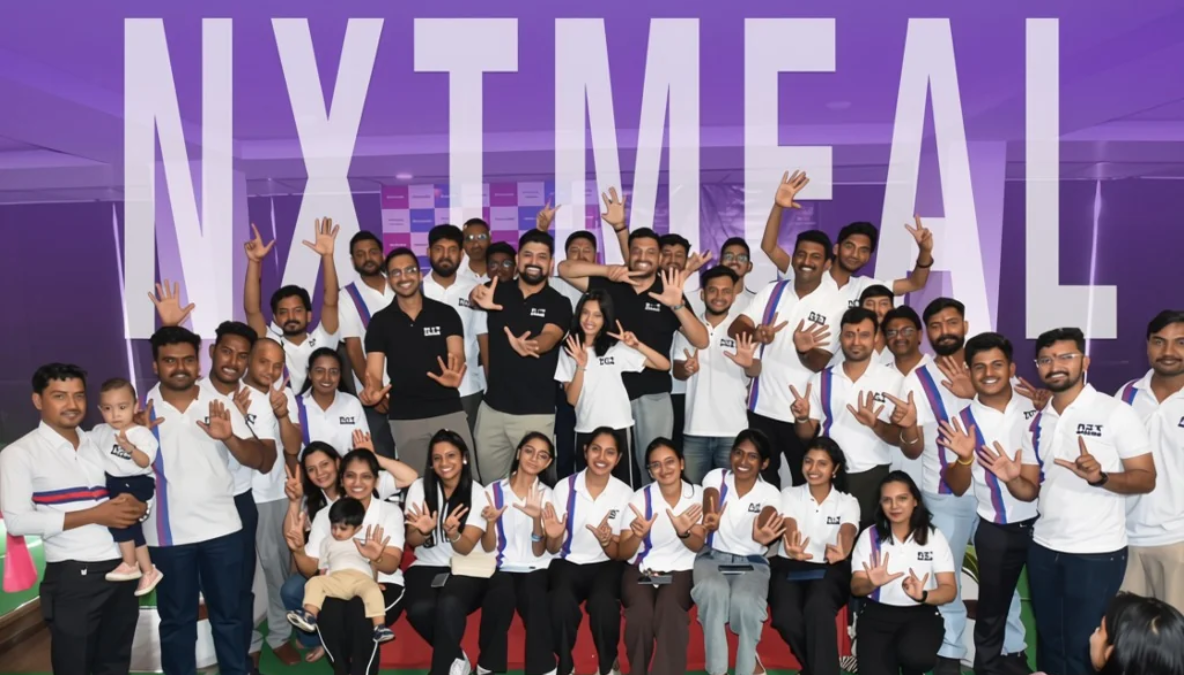
Nxtmeal, a Bengaluru-based corporate food services startup, has crossed ₹3 crore in monthly recurring revenue, the company says. Now it wants to turn that into ₹30 crore in revenue by the end of this financial year, and ₹100 crore the year after, starting with a new Nxtmeal Hyderabad kitchen.
The Bengaluru-based food-tech company has just taken its next step: a kitchen in Hyderabad, one of India’s big corporate and technology hubs. It has a capacity of about 2,000 meals a day and, the company says, business commitments worth around ₹15 lakh in monthly revenue already secured.
The big question is whether the Bengaluru model can be copied in other cities.
Nxtmeal at a glance
- Company: Nxtmeal, Bengaluru
- Founders: Sumeet Guleria and Milan Monappa
- Business: Technology-enabled corporate food services
- Monthly recurring revenue: About ₹3 crore, per the company
- Revenue target, current financial year: ₹30 crore
- Revenue target, next financial year: ₹100 crore
- New city: Hyderabad
- Hyderabad capacity: About 2,000 meals a day
- Hyderabad commitments: About ₹15 lakh in monthly revenue
- Technology platform: Octopus
What Nxtmeal does
Nxtmeal was founded by Sumeet Guleria and Milan Monappa. It runs a technology-enabled corporate food services business that goes beyond ordinary catering.
Its work spans corporate cafeterias, managed food services and cloud kitchens, along with several food formats designed around how people eat at work.
It operates in India’s organised food services industry. The company’s pitch fits a shift in that industry: businesses want professionally managed cafeterias, consistent food quality and food operations run with technology.
Nxtmeal’s Hyderabad expansion
Hyderabad is Nxtmeal’s newest market. The company describes it as an entry into another major corporate and technology hub.
- Capacity: About 2,000 meals a day.
- Commitments: Business worth around ₹15 lakh in monthly revenue is already secured.
- Unit economics: The company says it is approaching the expansion with an emphasis on sustainable unit economics, and expects its first Hyderabad kitchen to break even from the outset.
The company has not named its Hyderabad customers, and it has not said how many kitchens it plans to open there.

Nxtmeal revenue: the numbers behind the ₹100 crore goal
The targets are the real headline here. These comparisons are our own arithmetic, based on the company’s figures.
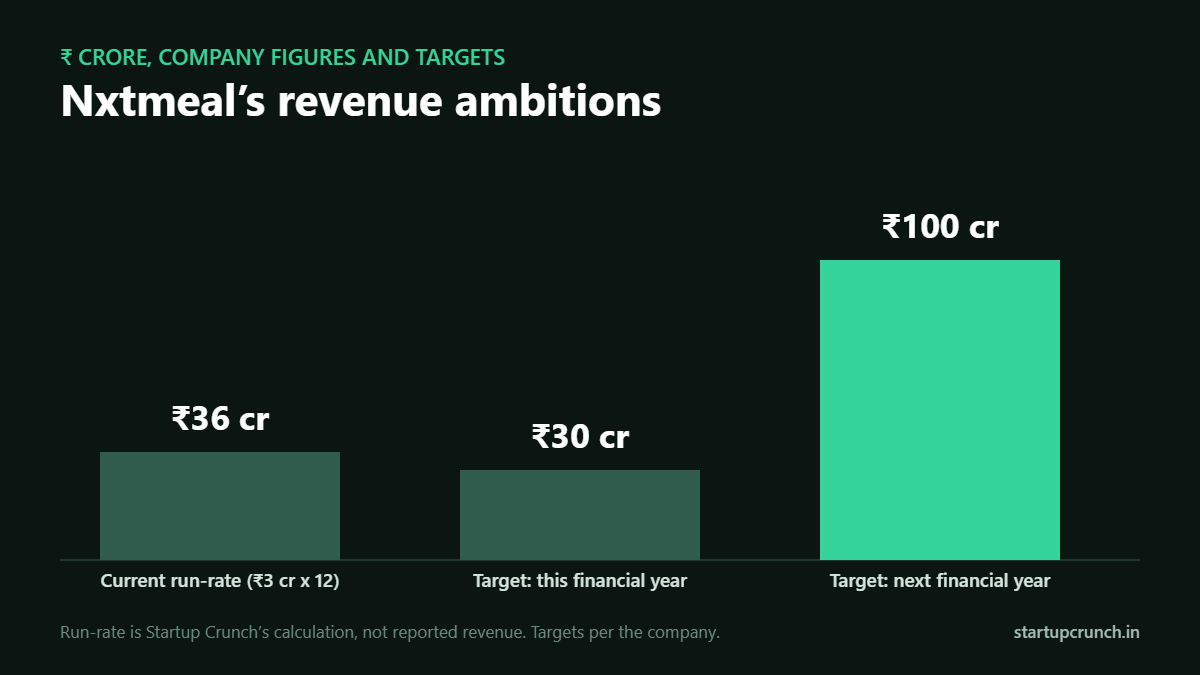
- ₹3 crore a month: If that level holds for a full year, it adds up to ₹36 crore. That would already be above the ₹30 crore target for this financial year. But monthly recurring revenue is not the same as revenue earned, and the company has not said when its financial year ends or how much it has earned so far.
- ₹30 crore to ₹100 crore: The next-year target is about 3.3 times the current-year target.
- ₹100 crore a year: That works out to about ₹8.3 crore a month on average.
- Hyderabad’s ₹15 lakh: That equals about 5% of ₹3 crore. It is a start, not a full picture, because it covers only commitments the company has secured so far.
These figures do not show profit. The company has not shared profit or loss, customer numbers or the number of cities it operates in.
Octopus: the technology behind the kitchens
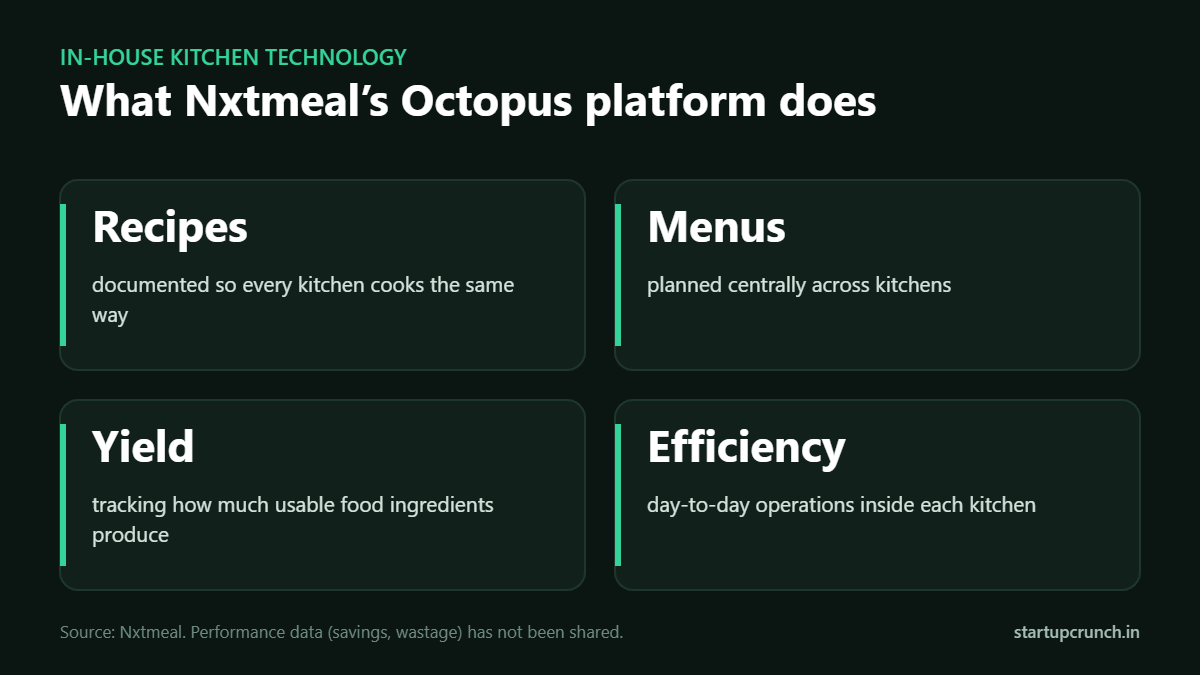
Nxtmeal runs its operations on an in-house technology platform called Octopus. The company says Octopus helps it streamline four things:
- Recipe documentation: Writing down recipes so they can be followed the same way in every kitchen.
- Menu planning: Deciding what to cook.
- Yield management: Tracking how much usable food comes from the ingredients.
- Kitchen-level efficiencies: Day-to-day operations inside each kitchen.
The company says the industry struggles with margins, food consistency, procurement and execution across many locations. Technology that standardises recipes and kitchen work is meant to tackle exactly those problems. The company has not shared how Octopus performs, such as cost savings or wastage reduction.
Why replication is the real test for Nxtmeal
Nxtmeal says it is building an ecosystem of food services and kitchen operations that can be replicated across markets, instead of relying only on traditional catering contracts.
That is a big claim, and a new city is where it gets tested. The company’s own list of worries covers what to watch: consistent food quality, procurement, margins and execution across locations.
The company’s own framing is that the bigger question is whether it can replicate its Bengaluru operating model across multiple cities, keeping quality, operational discipline and sustainable economics intact.
Hyderabad is the next test of that question.
Why Hyderabad matters for corporate food services
Hyderabad has become one of India’s fastest-growing office markets, with large technology campuses and global capability centres that feed thousands of employees every day. That makes it a natural second city for a company built around corporate dining. Many of these employers prefer a single vendor that can run cafeterias across several offices, which rewards caterers that can scale beyond one city.
It is also competitive. Large institutional caterers are expanding there too: Elior India, for example, has reported rapid growth in Hyderabad, according to The Tribune. For a younger company like Nxtmeal, winning corporate contracts will depend on price, food quality and the ability to deliver the same standard every day.
How the corporate food services model works
Corporate food services companies run cafeterias and meal programmes for businesses, usually under contracts that cover daily breakfast, lunch and snacks for employees. Revenue tends to be recurring, which is why Nxtmeal reports monthly recurring revenue, but margins are thin because food, staff and kitchen costs are high.
Scale helps. A kitchen that serves 2,000 meals a day can buy ingredients in bulk, plan menus in advance and spread fixed costs across more plates. That is where standardised recipes and yield tracking, the jobs Nxtmeal says Octopus handles, can make a real difference to profit.
The risk is that each new city brings new suppliers, new staff and new customer tastes. Keeping food consistent across locations is one of the hardest problems in the business, and it is the problem Nxtmeal says it has built its technology to solve. Read more of our consumer brands coverage and founder stories.
Who Nxtmeal competes with
India’s organised corporate food services market is crowded. Global caterers such as Sodexo, Compass Group and Elior run large cafeteria contracts for multinational companies, while Bengaluru-born HungerBox and SmartQ use technology to manage office cafeterias and food courts. Many companies also still work with local caterers on simple contracts.
Nxtmeal has not named its competitors. Its pitch is that it combines kitchen operations and technology in one model that can be repeated city by city, rather than acting as a traditional caterer. Whether customers see that as a real difference will become clearer as it bids for contracts in Hyderabad against these larger players.
What the founders are building
For Guleria and Monappa, the Hyderabad expansion is another step toward building a larger national business.
The company says that with ₹3 crore in monthly recurring revenue achieved, a ₹30 crore target this year and a ₹100 crore ambition for next year, it is preparing for a much larger play in India’s organised food services market.
What is not known
- Profit or loss: Not shared.
- Revenue so far this year: Not shared. The ₹3 crore is monthly recurring revenue.
- Customers: None named in Bengaluru or Hyderabad.
- Number of kitchens and cities: Not stated.
- Funding: The company has not said whether it has raised money.
- Opening date: Not given for the Hyderabad kitchen.
- Verification: All figures are the company’s own and have not been independently checked.
What to watch next
Watch for three things. First, whether Hyderabad’s kitchen breaks even as expected. Second, whether the ₹15 lakh in monthly commitments grows as the kitchen fills its 2,000-meal capacity. Third, whether Nxtmeal moves into more cities, which would be the strongest sign that the model travels.
Nxtmeal timeline
- Earlier: Nxtmeal builds a presence in Bengaluru and crosses about ₹3 crore in monthly recurring revenue.
- Now: The company enters Hyderabad, with about 2,000 meals a day of capacity.
- By the end of this financial year: Target of ₹30 crore in revenue.
- Next financial year: Target of ₹100 crore in revenue.
Frequently asked questions
What is Nxtmeal?
Nxtmeal is a Bengaluru-based food-tech company that runs technology-enabled corporate food services, including corporate cafeterias, managed food services and cloud kitchens.
Who founded Nxtmeal?
Nxtmeal was founded by Sumeet Guleria and Milan Monappa.
How much revenue does Nxtmeal make?
Nxtmeal says it has crossed about ₹3 crore in monthly recurring revenue. It has not shared annual revenue or profit figures.
What are Nxtmeal’s revenue targets?
The company is targeting ₹30 crore in revenue by the end of this financial year and ₹100 crore in the next financial year.
What is Nxtmeal’s Hyderabad kitchen capacity?
Its first Hyderabad kitchen can serve about 2,000 meals a day, and the company says it has already secured business worth around ₹15 lakh in monthly revenue.
What is Octopus?
Octopus is Nxtmeal’s in-house technology platform for recipe documentation, menu planning, yield management and kitchen-level efficiencies.
Has Nxtmeal raised funding?
The company has not said whether it has raised outside funding.