
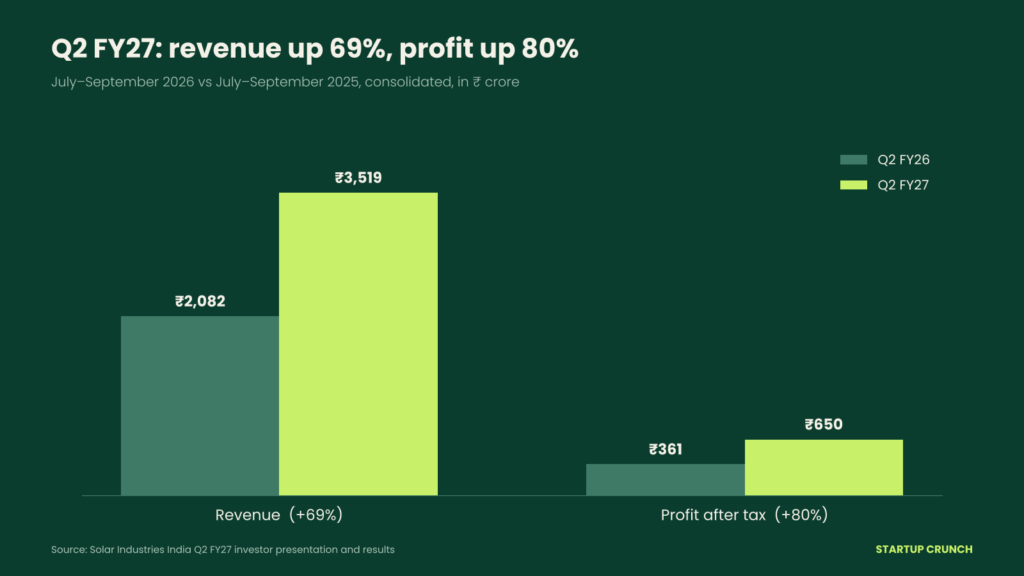
Solar Industries India reported a blockbuster second quarter. Consolidated revenue rose 69% year on year to ₹3,519 crore in the July–September quarter of FY27, up from ₹2,082 crore a year earlier. Profit after tax rose 80% to ₹650 crore, from ₹361 crore.
Operating profit grew even faster than revenue. EBITDA rose 75% to ₹1,021 crore, and the EBITDA margin widened to about 29%.
The company says it now expects to beat its revenue guidance for the full year.
But the headline numbers are only part of the story. The bigger change is what Solar Industries has become.
Defence is now the engine
Solar’s defence revenue almost doubled in the quarter, rising 98% to ₹1,002 crore. That is about 29% of total sales, up from a much smaller share a few years ago.
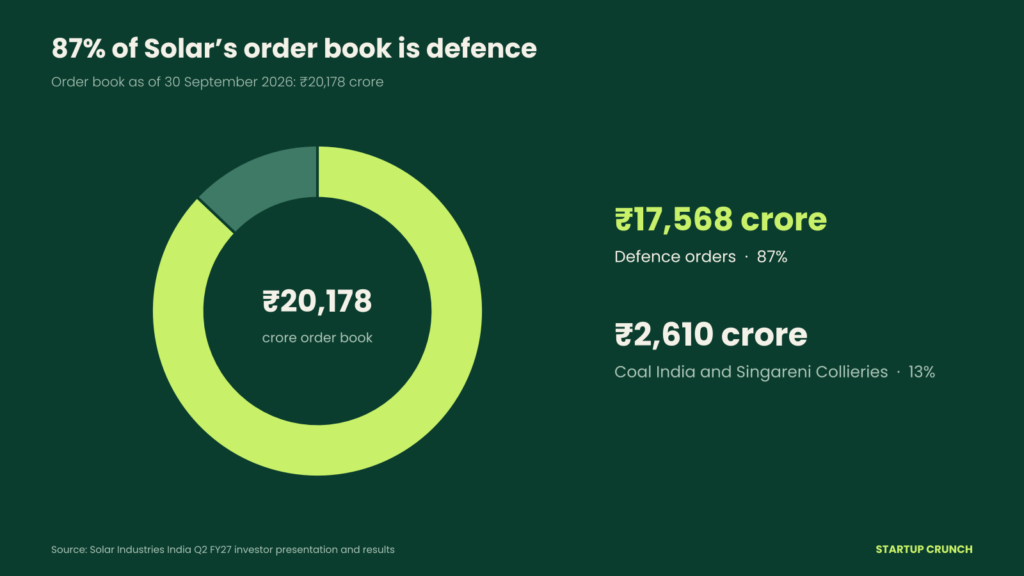
The order book tells the same story more strongly. At the end of September, Solar had orders worth ₹20,178 crore waiting to be delivered. Of that, ₹17,568 crore, about 87%, came from defence. The remaining ₹2,610 crore is tied to Coal India and Singareni Collieries, the mining customers the company was built on.
For the first half of FY27, revenue rose 70% to ₹7,187 crore, and profit after tax reached ₹1,316 crore.

From mining explosives to defence
Solar Industries started as an explosives business serving miners, not armies.
Its founder, Satyanarayan Nuwal, entered the explosives trade in 1979, supplying mining and construction companies. In the mid-1990s, the company set up its first factory near Nagpur, where it is still based, and Coal India became one of its most important customers. Industrial explosives for mines and infrastructure projects remained its core business for years, and the company also expanded into international markets, with operations in countries including Zambia, Nigeria and Ghana.
In 2010, Solar took a step that would change the company. It used its expertise in explosives and chemicals to enter defence manufacturing.
The bet took more than a decade to pay off at scale, but it has now become the company’s main growth driver.
The big defence wins
Two recent milestones show how far Solar’s defence business has come.
In February 2025, its subsidiary Economic Explosives Limited won a ₹6,084 crore contract from the Ministry of Defence to supply rockets for the Pinaka multiple rocket launcher system. It was the largest contract in the company’s history, and it marked the first time a private company won such an order for Pinaka rockets. The contract is to be executed over eight to 15 years.
In October 2026, another subsidiary, Solar Defence and Aerospace Limited, delivered 450 Nagastra-1R loitering munitions to the Indian Army. It was a follow-up to an earlier order for 480 Nagastra-1 units, which the company completed in December 2024. The company is also developing Bhargavastra, a low-cost system designed to counter drones.
Exports have started too. In January 2026, Solar dispatched its first consignment of guided Pinaka rockets to Armenia, part of a deal Armenia signed in 2022.
Why investors are paying attention

Solar’s rise reflects a broader shift in India’s defence policy. The government has been pushing to buy more weapons and ammunition from domestic manufacturers, and to open defence production to private companies that were once shut out.
For a company like Solar, that creates a long runway. Defence contracts tend to be large and run for many years, which gives investors visibility into future revenue. A ₹17,568 crore defence order book is worth roughly five times its quarterly revenue, by Startup Crunch’s calculation.
Defence also brings higher-value work. Making rockets and drones requires more technology and engineering than making industrial explosives, and the latest quarter’s rising margins suggest that mix is starting to help profits.

The challenge ahead
The opportunity comes with real risks.
The first is execution. An order book is a promise, not revenue. Solar has to build factory capacity, hire skilled people and meet strict quality and delivery deadlines for military customers. Delays in defence contracts can be costly, both financially and for reputation.
The second is concentration. With 87% of its order book tied to defence, Solar depends heavily on government spending and procurement timelines, which can change with budgets and policy.
The third is money. Expanding defence production and the international business at the same time requires heavy investment in plants, raw materials and working capital. Solar will need to fund that growth without stretching its balance sheet.
And because its shares already trade at a premium valuation, investors will expect Solar to keep delivering. Any slowdown in execution could hit hard.
What it means
For founders, Solar Industries is a lesson in patience and adjacency. It did not jump into a new industry from scratch. It used skills it had built over three decades in explosives and chemicals to enter defence, then spent more than 15 years building that business into its main source of growth.
For India’s defence sector, Solar shows how private manufacturers are moving from supplying components to delivering complete systems, from rockets to drones, and even exporting them.
What to watch next
Three things will show whether Solar’s defence story keeps working: how quickly it turns its ₹17,568 crore defence order book into revenue, whether it wins more export orders, and whether margins and finances stay strong as it invests to expand.
