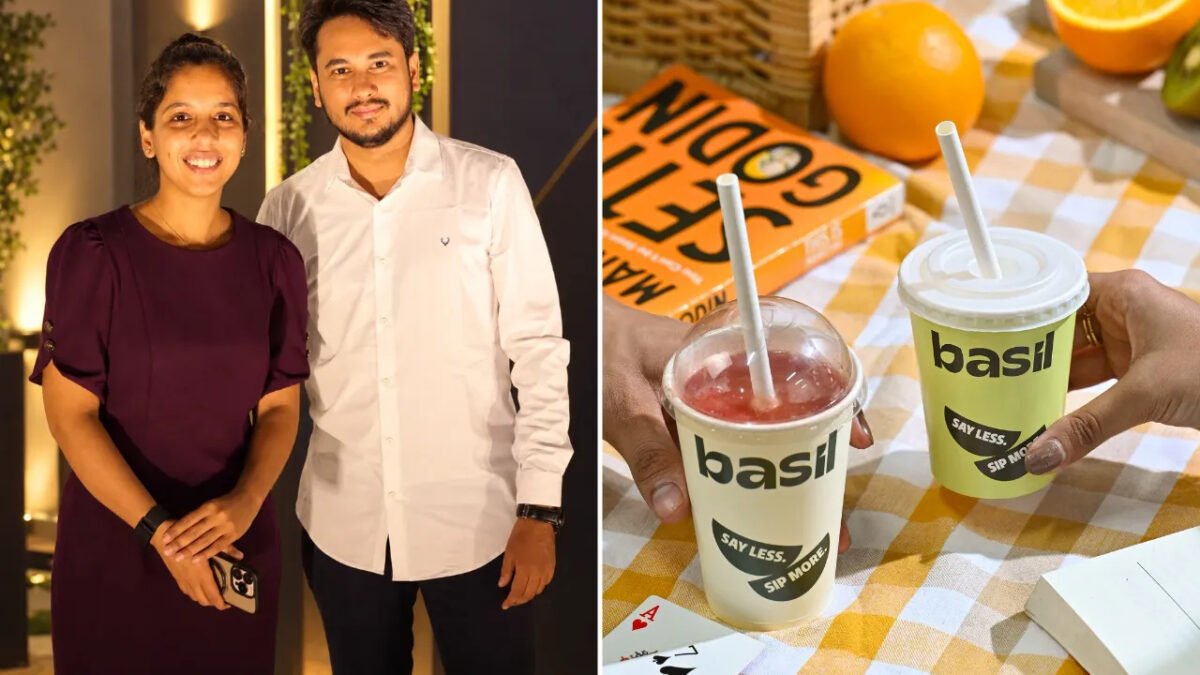
Basil, a Delhi-based healthy food and beverage brand, says it has made ₹13.65 crore in revenue so far in 2026, already well above its full-year revenue for 2025. The company says it has served more than 2 million customers through over 70 compact kiosks and automated beverage machines in Delhi NCR, Bengaluru and Chandigarh.
Founded in 2021 by Harshita Kejriwal and Akshay Chaudhari, Basil sells fresh drinks and snacks without refined sugar, artificial sweeteners, colours or flavouring. Its kiosks sit where people already spend their day: malls, hospitals, universities and corporate tech parks.
The numbers so far
Basil’s growth has picked up sharply over the past three years. The company says revenue was ₹3.85 crore in 2024 and ₹8.08 crore in 2025. With ₹13.65 crore booked so far in 2026, it is already about 69% ahead of last year’s total, by Startup Crunch’s calculation, with the year not yet over.
These figures come from the company and have not been independently audited. Basil has not shared its revenue for 2023, its margins, or how much a kiosk earns on its own.
Customers spend ₹250 to ₹300 per order on average, according to the company. Drinks make up about 80% of what it sells, and food the rest.
Who is behind Basil
Harshita Kejriwal, 30, is a Delhi native with a bachelor’s degree from IIT Delhi. She worked as a research intern at ITC Group and Imperial College London, and spent nearly two years as a consultant at Boston Consulting Group.
The idea came from her own frustration. Travelling for work, she found it hard to get food that was quick, fresh and actually healthy.
Akshay Chaudhari, 31, holds an M.Tech from VIT and has worked as a Senior Analyst at Capgemini and as a Project Lead at Xook. His contribution was the technology side: using robotics and automation to serve places where a full kiosk with staff would not make financial sense.
“We don’t aspire to just be in every city. We aspire to be in every routine,” Harshita Kejriwal says.
How the kiosks and machines work
Basil runs two formats. The first is a compact kiosk, a small staffed counter placed inside a mall, hospital or office campus. The second is an automated blending machine that prepares drinks without a full team behind the counter.
The founders say the machines reduce dependence on staff and cut pilferage, a common problem in food retail where stock goes missing. They also make it possible to serve lower-footfall sites, such as a smaller office building, where a staffed kiosk would struggle to cover its costs.
Both formats were built by a third-party manufacturer. Behind them sits a central kitchen and warehouse that supplies every location.
What “clean” means on the menu
Basil’s pitch rests on ingredient swaps that customers can understand at a glance. According to Kejriwal, the company uses honey and dates instead of refined sugar, fresh fruit instead of syrups, olive oil instead of palm oil, hung curd instead of mayonnaise, and millet instead of maida.
The menu runs from cheaper refreshers, tea and hummus-based snacks to higher-priced protein drinks, detox drinks, boosters and smoothie bowls.
For a fresh-food brand spread across 70 locations, consistency is the hard part. Basil says it uses standard recipe books at every kiosk, runs monthly quality and operational audits, carries out pest control twice a month at each store, and tests its water through authorised labs to meet food safety rules.
Bootstrapped first, funded later
Basil started with just ₹2 lakh to ₹3 lakh of the founders’ own money, which covered recipe development, ingredients, inventory, packaging and early running costs. The founders spent that period testing and refining products before spending heavily on marketing or large-scale manufacturing.
The company later raised an undisclosed pre-seed round from a venture capital firm. In March 2026, it raised $1.5 million in a pre-Series A round led by Whiteboard Capital, Brigade REAP and Barbershop Fund.
Its first customers came from talking to people at its first outlet rather than paid ads. Today it uses on-ground activations, influencers, social media and WhatsApp and SMS campaigns. Instagram drives discovery, while LinkedIn is where the founders talk about growth.
Basil has also partnered with FoodPharmer’s protein brand OWN on a protein drink subscription. The company says it sold 60 kg of protein in the first week of the partnership, compared with about 80 kg in the whole previous month.
What comes next
Over the next 12 months, Basil plans to grow to 200 to 300 stores and enter new cities. Over five years, it is aiming for 1,000 kiosks across India’s top ten cities and 10,000 automated machines in workplaces, schools, hospitals, retail spaces and transit hubs.
Those are ambitious targets for a company with about 70 locations and a team of more than 200 people today. Growing from 70 to as many as 300 stores in a year would mean opening several new locations every week, while keeping fresh food consistent everywhere.
What it means
For founders, Basil shows a different route into India’s healthy-food market. Instead of building a delivery-only brand that competes for attention on food apps, it is placing small, low-cost points of sale inside places people visit every day. Automation then lowers the cost of each new location.
For readers, the bigger question is price. A ₹250 to ₹300 order is affordable for office workers in a tech park, but still a treat for most Indians. Basil’s real test will be whether it can bring healthy food into daily routines beyond the country’s most expensive campuses.
For now, the trend in its own numbers is clear: revenue more than doubled last year, and this year has already passed it.